Newsletter Subscribe
Enter your email address below and subscribe to our newsletter

 ByJohn A
AI in student learning analytics converts raw educational data into actionable insights on engagement, risk, and outcomes. It supports evidence-based decisions through dashboards, indicators, and timely feedback. Guardrails address equity, privacy, and ethics, ensuring transparency and bias mitigation. The process requires careful data-source selection, deployment choices, and clear success metrics. This framework invites systematic evaluation and iterative refinement, leaving educators with concrete questions about implementation and impact to pursue next.
AI in learning analytics serves to transform raw educational data into actionable insights about student behavior and outcomes. The approach quantifies engagement, identifies at‑risk patterns, and forecasts performance, enabling evidence‑based decisions. Rigorous evaluation ensures reliability, while governance structures uphold AI ethics, data governance, AI privacy, and data security. Transparent methodologies empower educators to act with freedom and accountability.
To convert analytics into meaningful learning support, educators translate observed data into timely, personalized feedback that guides student action.
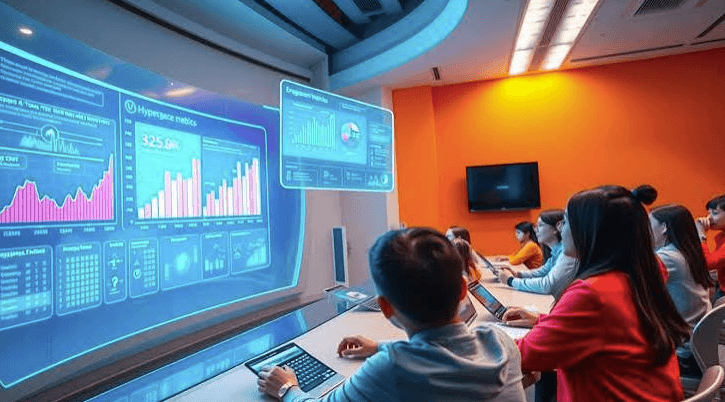
Data visualization distills performance signals into actionable steps, enabling instructors to tailor interventions precisely when needed.
Feedback integrates learner sentiment, clarifying motivation and barriers.
Implementations rely on iterative monitoring, transparent benchmarks, and scalable dashboards that empower students to adjust strategies autonomously.
The approach emphasizes privacy safeguards, rigorous data governance, and transparent processes.
It outlines bias mitigation, equity considerations, and accountability, enabling evaluators to interpret analytics without overreach, while maintaining methodological rigor and learner trust.
The process identifies Choosing data sources to ensure representativeness and bias mitigation, selects Deploying models that meet performance and scalability criteria, and defines measurable outcomes.
Continuous monitoring supports iterative refinement and evidence-based decision making.
Students benefit daily from AI-driven analytics by receiving targeted feedback, personalized pacing, and actionable insights; however, caution is warranted regarding insight fatigue and data privacy to maintain autonomy and trust in the learning process.
Educators require strong data literacy and governance skills to use analytics effectively, overcoming concerns about privacy. They should interpret dashboards, validate sources, and apply findings; this ensures responsible, transparent practice aligned with data governance and data literacy principles.
AI can reduce workload on teachers without compromising quality, but only when integrated with rigorous data practices; AI workload management and monitoring ensure teaching quality remains high while freeing time for targeted instruction and reflective practice.
Motivation is tracked via observable behaviors and self-report measures, juxtaposing quantitative dashboards with qualitative reflections; ethically characterized by ethical transparency and bias detection, enabling adjustments while preserving learner autonomy and data integrity in transparent, data-driven practices.
See also: sportnewsplanet
Invalid data are flagged for review; misinterpretation signals trigger audits and model recalibration. Data privacy is maintained throughout, with transparent reporting. The system documents fixes, communicates limitations, and prevents erroneous actions, preserving trust while supporting continuous, evidence-based improvements.
In the ledger of a classroom, AI Analytics stands as a steady metronome: data points ticking into insight, each beat aligning with learner trajectories. Guardrails form the fortress walls, ensuring equitable light threads through every corridor. Dashboards glow like compass roses, guiding educators toward timely, personalized actions. Privacy, ethics, and governance are the quiet ballast beneath the surface, keeping currents predictable. When deployed with measured metrics, the system charts a transparent map from raw data to student outcomes.